Showing posts with label Robert. Show all posts

Monday, July 18, 2022

Leslie Gadallah and Canadian Space Opera

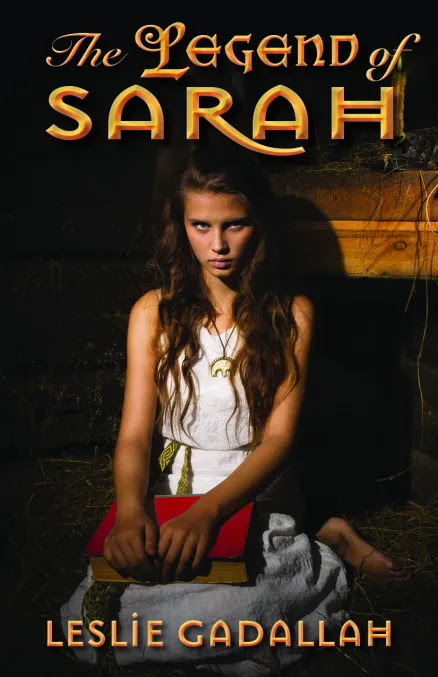
My essay, "Leslie Gadallah and Canadian Space Opera" has been reprinted on the Shadowpaw Press website to correspond with the re-release of Gadallah's The Legend of Sara.

I am incredibly happy to see the Legend of Sara back in print for the third time (after Five Rivers closed shop) as it is one of my all-time favourite Canadian SF novels. My essay was originally the Afterword in the Five Rivers edition, so contains spoilers--no reading it before the book! If you haven't read the book yet, go buy it! You won't be disappointed.

Friday, October 15, 2021

New Story Published

My short story, "The Changeling and the Bully" was published today in Mythic #17. It's the first story in my urban fantasy series: not quite the origin story since our protagonist's backstory comes out bit by bit as things progress, but this is the story where the major characters meet for the first time. (It does not go well.) Previous stories in the series have been published by First Line Literary ("Ransom and the Open Window") and Apex and Abyss ("Ransom and the Xmas Tree").

I currently have six more finished, two more that are half done....and a bunch more ideas that may or may not work out. The plan was to follow these characters from high school until old age, but they went and had kids in "Ransom and the Baby" so now it looks like the kids are going to keep the series going....

Wednesday, August 04, 2021

New Short Story in On Spec Magazine

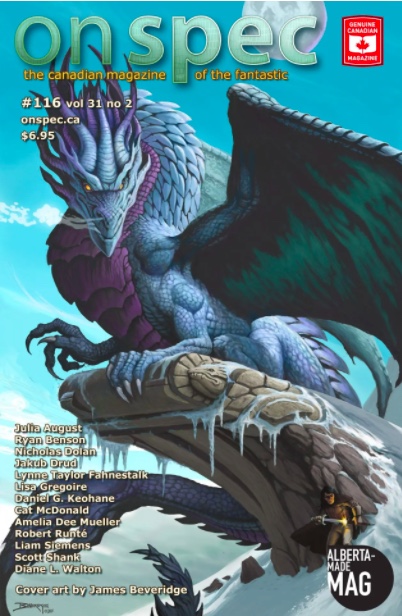
My short story, "Hand Delivered", (a prequel to my WIP-novel) came out in On Spec Magazine, #116, (June, 2021).

Amazing Stories' reviewer (and the editor of Polar Borealis) Graeme Cameron, called it "Enjoyably old-fashioned space opera, yet psychologically astute and offering much food for thought."

The same issue features Cat Mcdonald's in depth interview with me, which Cameron also included in his review, calling it "tremendously inspirational" and that "it’s crammed with pertinent and valuable advice on writing and editing. You owe it to yourself to read it."

So pretty pleased with all of that.

Wednesday, March 31, 2021

New Short Story Published

Just received my copy of Mythic #15 with my story, "Jerry" in it. Pleased to find my name on the cover, rather than my usual "and other stories" spot.

Wednesday, January 06, 2021

Pushcart Nomination

I am honoured that editor Janna Liggan nominated my story, "Weathering" for a Pushcart Award as one of the six best of the year in Lamplit Underground Magazine.

The story is available to read free at https://online.fliphtml5.com/dnitz/jtai/#p=12

Thursday, November 19, 2020

Fatal Flaw Magazine

Pleased that my drabble (which is a story exactly 100-words long) "Perfect Storm" was published today by Fatal Flaw magazine in their special "unreliable narrator" issue. It's available to read free here:

https://www.fatalflawlit.com/unreliable-flash/perfect-storm

Wednesday, October 14, 2020

Tuesday, August 25, 2020

The Elixir of Life

 I enjoy CBC's Grown-ups Read What They Wrote As Kids,  so in the same spirit, here is my major creative writing assignment from Grade 6*.

Clearly, a budding genius even then.

I'd kept it all these years partly because I was raised by a hoarder who taught me one must never throw anything of that sort out; and partly because I was aware that I would someday become a teacher and would need to calibrate my expectations for students by comparing their work with mine at a similar age, as opposed to against the great masters of literature, which seemed to me at the time to be the bar. I didn't become a Grade 6 teacher, but I did have daughters, both of whom were greatly relieved that no matter how bad their own Grade 6 writing, they were considerably better than their dad. I also kept all my university papers, and looking back at those periodically has kept me humble and a better marker. "These kids today don't know anything!" is a common refrain, but people forget how they didn't know much as an undergrad either--kind of the point of going to university, really.

I also clearly remember being concerned my teacher would think I had plagarized from Marion Zimmer Bradley's The Colors of Space which I had read as I started outlining for the assignment and by which I was greatly inspired. I had only discovered Science Fiction half-way through Grade 6, and Bradley's was perhaps the second or third book of that sort that I had read, so my limited familiarity with the field meant that I thought I was copying by having, you know, spaceships. In retrospect, I'm fairly certain anyone would be hard-pressed to find any parallel between the two works.

Wednesday, July 15, 2020

New Short Story: Deep Dive


My short story "Deep Dive" is posted on Ariel Chart International Literary Magazine at 
https://www.arielchart.com/2020/07/the-deep-dive.html

My thanks to Senior Editor Jana Begovic for choosing it.

Wednesday, June 20, 2018

The Destruction of Planet Zor

Today's launch of Sherry Ramey's mid-grade SF adventure, Planet Fleep, reminds me of my own attempt to launch Planet Zor. Enough time has passed that I can tell that story here without hurting anyone's feelings (and they can't fire me over it at this late date) so here goes:

Back in the 1980s, I was in charge of compiling (which usually meant actually writing most of it myself) the Grade 3 Social Studies provincial exam. The exam had significant issues, chief among them all the research available that said Grade 3 students couldn't write multiple-choice questions and that the concept of a Grade 3 examination was a stunningly stupid idea. I had read all that research, compiled it for my then boss, who agreed with me, but such decisions are not made by the technical experts but by politicians. We were, therefore, going to have a provincial Grade 3 examination one way or another, so up to me to make it the least ghastly possible. (To their credit, the team did come up with a number of innovations that did make things better, and for a while there we were able to resist political pressure to keep the results from affecting the students' grades, but all that is a story for another time...)

One of the key concepts for Grade 3 Social Studies was "culturally distinctive communities" and the understanding of why, in Canada's multicultural society, some people want to preserve the traditions of their homelands while living in Canda. This presented two problems to me.

First, being a province-wide test, I had to be fair to everybody, but the curriculum encouraged each community to take as their case study in the course their own culturally distinctive communities. So students in Southern Alberta studied the Hutterites, because that's where most Hutterite colonies are, but students in Calgary studied Chinatown because Calgary still has a vibrant Chinatown, and kids in Northern Alberta studentied the Old Believer colonies and so on. Which makes it impossible to take a case study on the test that everyone had studied, so I would necessarily be biasing the exam depending on whether I used one case study or another.

The second problem was, when I got teams of Grade 3 teachers together to write questions on "culturally distinctive communities" it quickly became painfully obvious that these white English middle-class ladies had absolutely no idea why anyone would want to retain their culturally distinctive community. They all tried valiantly to understand what was to them a mistaken desire of these communities to hold onto a dead past, but um, I couldn't use anything they wrote. It was terrifying that the teachers did not get the curriculum objective here themselves, let alone teach it to children. (I like to think the situation is better today as all the work on addressing First Nations content over the last couple of decades might have given the general population, including Grade 3 teachers, at least a glimmer of why multiculturalism is a better idea than assimilation. But then, I'm a hopeless optimist.)

Anyway.

As much as I tried to come up with generalizable questions on "culturally distinctive communities" that would apply to all cultures everywhere--that can't be done. Being an SF reader, however, I hit upon the idea of writing the test about human emigration to the Planet Zor and why some humans might wish to retain their human culture, even when living among the friendly Zorians. So my artist and I worked together on mocking up a unit on the Planet Zor and why some humans preferred to stick with their own holidays rather than celebrate Ko Day, and so on. Problem solved. I wasn't biasing the test by which case study the class happened to take in their community because Zor would be new to all of them; and putting the kids in the position of a human among Zorians was a pretty good way of getting them to think about why people want to retain their "culturally diverse" community.

The artist and I presented the mock-up to my boss. Who immediately got it, but said NO in no uncertain terms. "I can't put science fiction on a provincial exam! What were you thinking! Zor is not part of the curriculum, and I did not authorize this!"

I may have argued back a bit. Like a lot. Because it was the only possible solution to my problem, and the artist's illustrations were brilliant, and the two of us had already talked about doing the book that would be used in every grade 3 classroom in the province, because this was gold, right?

But my boss was adamant--in spite of conceding the logic of my argument--because he was convinced science fiction was simply a nonstarter with the public. When I argued that it was no longer a nonstarter in the age of Star Trek and Star Wars and so on, he retreated to his ultimate defense which was, "You could never get it past the Committee."

The Committee was actually one of several that oversaw our work, and had absolute veto power, as it should, since it consisted of representatives of all the relevant stakeholders (except parents and students, of course--another one of my suggestions that went nowhere) and the Committee was inclined to err on the side of caution.

So having had Zor shot down by my boss in anticipation of a 'no' from the committee, he set us to chose the culturally distinctive community of Old Believers because that represented the smallest population in the province, so probably new to most students. *sigh* All work on Zor stopped, and we struggled to put together a test on the Old Believers about which none of us knew very much, and very little of which would fit into the Grade 3 curriculum.

And my boss explicitly ordered my colleagues and I NOT to mention Zor to the Committee because we were a team, and the team had to present a common front to the Committee, so whatever arguments we were free to have among ourselves, we must toe the line when facing those outside the office, etc.

So his was the exam we wrote and took to the Committee which said, "you can't just take one community at random; that's not fair to everybody who studied a different one. And what are you going to do next year, and the year after that? If you always use Old Believers, then everybody will end up studying them to do well on the exam. And if you rotate communities through the test, then some students will be advantaged over others." And so on. Round and round we went with the impossibility of making any of this work. My frustration at not being allowed to even suggest the possibility of the obvious solution of Zor grew steadily throughout the day of the meeting, but my hands were tied, as were my colleagues' who knew about and thought the artist's illustrations for Zor were pretty awesome.

Near the end of the day, one of the Senior members of the committee looked up from the draft exam and said, "I don't know...why don't you have something like a Canadian going to an alien planet? Kids today love SciFi, and that way, it would put them in the shoes of someone trying to hang onto their own culture." And then he stopped talking because I and my colleagues were glaring at my boss.

"Did I say something wrong?" the Committee member asked, confused by our reaction.

There was a long pause as I continued to glare at my boss with the "I was right, you were wrong, and I'm probably going to find a way to kill you" look.

And then my boss turned to the Committee member and reassured him, "No, no, you said nothing wrong. It's just...that's a bit of a Zor point with my staff."

To the eternal confusion of the Committee members, I exploded into laughter, and my closest colleague fled the room to keep from doing the same. She returned, grinning, and announced, "I just needed a refill" holding up her coffee and trying not to weep with laughter. Because, of course, my boss' terrible pun was both acknowledgment and apology. After the meeting my boss shrugged and said, well it's too late to go back to Zor, so we'll have to move forward with this version for this year, but, we'll see for next time. But the Grade 3 Social Studies exam only happened every three years, so by next time both the artist and I had left for other careers, and Zor never happened.

I still wished we had written that textbook, though.

[I'm out of town at the moment, but will add some of the illustrations from Zor when I return home. I wanted to post this today, while the opening line was still true.]

Friday, May 18, 2018

And Another Thing

Reprinted from Rhonda Parrish's blog series And Another Thing: More about Candas Jane Dorsey each Friday in May related to the release of Prairie Starport: A Story Collection in Celebration of Candas Jane Dorsey

Candas as Role Model

By Robert Runté

I confess when I was younger, I found Candas a somewhat intimidating figure.

She was, after all, courageously following her bliss to live the life of a writer; whereas I had cowardly chosen employment for which one might actually get paid. I greatly envied her freedom and personal fulfilment, as I toiled 9 to 5 in my government job.

I was astonished by her ability to sit down and write without angst, to produce in twenty minutes a document that would have taken me all day, had I been able to manage the task at all. She was and remains a model of efficiency and effective writing, concise and on target in every instance.

I greatly admired her intuitive leadership skills, among which was the ability to move others to action: anyone who fell into her orbit was likely to discover they had somehow volunteered to sit on Boards, or to organize readings, or to make cold calls for some cause, or to otherwise be doing things they would not, in the normal course of events, have thought of doing.

I was somewhat overawed at her weekly salons in which the artistic elite of Edmonton, and frequently the literary greats from beyond, would sit around her living room debating the nature of writing, the cost of tomatoes, and similar eternal verities. It was sobering to discover that writers were real, that there were more of them about than one would have imagined, and that one did not have to travel to Toronto or New York to meet them.

And, being somewhat socially awkward, I was frequently thankful for her frank advice on a variety of topics concerning how one should move through the world, such as pointing out on one memorable occasion, that my attempts not to disrupt the proceedings had been far more disruptive than the initial disruption.

So.

It is possible that on occasion I allowed my better judgement to be overwhelmed by Candas’ unassuming charisma.

I recall one afternoon attending at her house and, having no response to the doorbell, took the initiative of going round the back to intrude upon the privacy of her garden. I found her sitting next the flower bed examining a bloom with flat, but colorful petals.

“Here, eat this,” Candas said, handing me the flower.

Internally, I dithered. On the one hand, this was well before my culinary horizons had expanded much beyond burgers, and food prejudices being among the most strongly held, I did not wish to eat a flower. On the other hand, I did not wish to appear unsophisticated, and I considered carefully that there was no logical reason not to eat the offering. After all, Candas was hardly going to hand me a dangerous herb or one which she did not routinely consume herself. As in so many other cases, I should follow her lead to experience new things and benefit from our fellowship. And, knowing Candas’ powers of persuasion, I recognized that I was going to eat the flower in the end, and the only real question was whether I would do so after my usual whimpering hesitation, or man up and eat the damn thing as if that were a perfectly natural thing to do.

I stuffed it in my mouth and chewed, hopefully before my hesitation was detected.

Candas watched me carefully. I refused to allow any of my consternation to show on my face.

“Well?” Candas asked.

“What kind of flower was it?” I inquired, once I had swallowed.

She named the variety, though in truth the knowing of it made me none the wiser.

“So?” Candas asked. “What does it taste like?”

“What?”

“Well, I’ve always wondered what they tasted like, but I could never quite bring myself to eat one.”

“What!”

“Would you describe the flavour as ‘delicate’? It’s for a scene I’m writing.”

I like to believe that this was an important turning point in my maturity. As with so many other occasions, Candas had introduced me to an important concept, in this case something about not giving into peer pressure, especially when the pressure was entirely in my own head.

Candas, of course, has always been mystified by any suggestion she is intimidating. She considers herself perfectly normal. Which, considering her accomplishments, is a pretty intimidating standard against which to be held.


Saturday, May 27, 2017

Aurora Award Nomination


Dr. Runté poses with cover of Strangers Among Us anthology which garnered six Aurora Award nominations on the 2017 ballot.

The Canadian Science Fiction and Fantasy Association has released the Aurora Award Ballot for 2017, and I am honoured to be included on the shortlist for one of my short stories, "The Age of Miracles".

"Age of Miracles" was published in the anthology Strangers Among Us: Tales of the Underdogs and Outcasts, edited by Susan Forest and Lucas Law. The anthology's theme was speculative fiction addressed to issues of mental health, and my story looked at how someone with schizophrenia might navigate the world of the near future. (It plays on the idea that if we see someone on a corner talking when there is nobody else there, how do we know whether they are crazy or just talking on their cell phones?)

I'm pretty pumped that my story made the ballot, because humour is often a hard sell, especially when up against excellent serious stories, and the Strangers Among Us anthology alone had a number of outstanding stories, let alone the rest of the field this year.

The CSFFA makes available a voter package with the nominated stories/books/comics/artwork (or as many of those that publishers permit) for all CSFFA members, so voters can base their decisions on actually having read/seen the nominated works. Membership in CSFFA is only $10 a year, so the voter package is a great opportunity to see the best of Canadian SF&F, as nominated by CSFFA members. Additionally, again this year Kobo Canada has donated a Kobo for a prize draw for one lucky randomly chosen voter to encourage voter turnout. So $10 buys you the right to vote, the right to read some great Canadian SF, and a chance at a free ebook reader. Join here.

Here's the 2017 ballot:

The 2017 Aurora Award Ballot

This ballot is for works done in 2016 by Canadians. The Aurora Awards are nominated by members of the Canadian Science Fiction and Fantasy Association. The top five nominated works were selected. Additional works were included where there was a tie for fifth place.

Best Novel
Children of Earth and Sky by Guy Gavriel Kay, Viking Canada
Company Town by Madeline Ashby, Tor Books
The Courier by Gerald Brandt, DAW Books
The Nature of a Pirate by A.M. Dellamonica, Tor Books
Quantum Night by Robert J. Sawyer, Penguin Canada
Stars like Cold Fire by Brent Nichols, Bundoran Press

Best Young Adult Novel
Day of the Demon by Randy McCharles, CreateSpace
Door into Faerie by Edward Willett, Coteau Books
Heir to the Sky by Amanda Sun, Harlequin Teen
Icarus Down by James Bow, Scholastic Canada
Mik Murdoch: Crisis of Conscience by Michell Plested, Evil Alter Ego Press
The Wizard Killer - Season One by Adam Dreece, ADZO Publishing

Best Short Fiction
"Age of Miracles" by Robert Runté, Strangers Among Us: Tales of the Underdogs and Outcasts, Laksa Media
"Frog Song" by Erika Holt, Strangers Among Us: Tales of the Underdogs and Outcasts, Laksa Media
"Living in Oz" by Bev Geddes, Strangers Among Us: Tales of the Underdogs and Outcasts, Laksa Media
"Marion's War" by Hayden Trenholm, Strangers Among Us: Tales of the Underdogs and Outcasts, Laksa Media
"Seasons of Glass and Iron" by Amal el-Mohtar, The Starlit Wood: New Fairy Tales, Saga Press
"When Phakack Came to Steal Papa’s Bones, A Ti-Jean Story" by Ace Jordyn, On Spec Magazine

Best Poem/Song
No award will be given out in this category in 2017 due to insufficient eligible nominees

Best Graphic Novel
Angel Catbird, Volume One by Margaret Atwood, Johnnie Christmas and Tamra Bonvillian, Dark Horse Books
Crash and Burn by Kate Larking and Finn Lucullan, Astres Press
Earthsong by Crystal Yates, Webcomic
It Never Rains by Kari Maaren, Webcomic
Weregeek by Alina Pete, Webcomic

Best Related Work
Clockwork Canada: Steampunk Fiction edited by Dominik Parisien, Exile Editions
Enigma Front: Burnt, managing editor Celeste A. Peters, Analemma Books
Lazarus Risen edited by Hayden Trenholm and Mike Rimar, Bundoran Press
Strangers Among Us: Tales of the Underdogs and Outcasts, edited by Susan Forest and Lucas K. Law, Laksa Media
Superhero Universe (Tesseracts Nineteen) edited by Claude Lalumière and Mark Shainblum, EDGE

Best Visual Presentation
Arrival, director, Denis Villeneuve, Paramount Pictures
Orphan Black, Season 4, John Fawcett and Graeme Manson, Temple Street Productions
Killjoys, Season 2, Michelle Lovretta, Temple Street Productions
Dark Matter, Season 2, Joseph Mallozzi and Paul Mullie, Prodigy Pictures
Murdoch Mysteries, Season 9, Peter Mitchell, Shaftesbury Films

Best Artist
Samantha M. Beiko, cover to Strangers Among Us anthology
James Beveridge, covers and poster art
Melissa Mary Duncan, body of work
Erik Mohr, covers for ChiZine Publications and Company Town for Tor Books
Dan O'Driscoll, covers for Bundoran Press

Best Fan Writing and Publications
Amazing Stories Magazine, weekly column, Steve Fahnestalk
BCSFAzine #512 to #519, edited by Felicity Walker
The Nerd is the Word, articles by Dylan McEvoy
OBIR Magazine #4, edited by R. Graeme Cameron
Silver Stag Entertainment, edited by S.M. Carrière
Speculating Canada edited by Derek Newman-Stille

Best Fan Organizational
Samantha Beiko and Chadwick Ginther, co-chairs, Chiaroscuro Reading Series: Winnipeg
R. Graeme Cameron, chair, VCON 41, Surrey, BC
Sandra Kasturi and Angela Keeley, co-chairs, 2016 Toronto SpecFic Colloquium
Derek Künsken and Marie Bilodeau, executive, Can*Con 2016, Ottawa
Randy McCharles, chair, When Words Collide, Calgary
Matt Moore, Marie Bilodeau, and Nicole Lavigne, co-chairs, Chiaroscuro Reading Series: Ottawa
Sandra Wickham, chair, Creative Ink Festival, Burnaby, BC

Best Fan Related Work
Ron S. Friedman, Villains and Conflicts presentation, When Words Collide, Calgary Comic Expo, and File 770
Kari Maaren, Concert, SFContario
Derek Newman-Stille, Speculating Canada on Trent Radio 92.7 FM

Best of the Decade
This is a special category for this year’s awards for works published between January 2001 and December 2010. Note: Items in italics are for multi-volume works. Multi-volume stories were considered if they began prior to 2001 but ended before or close to 2011. We defined a multi-volume story as one with a continuous narrative. Finalists were chosen by an eight-person jury from across Canada. The winner will be chosen by our membership’s votes.

Blind Lake by Robert Charles Wilson, Tor Books
The Blue Ant Trilogy by William Gibson, Berkley
Malazan Book of the Fallen, Steven Erikson, Tor Books
The Neanderthal Parallax, Robert J. Sawyer, Tor Books
The Onion Girl, Charles de Lint, Tor Books
Under Heaven, Guy Gavriel Kay, Viking Canada


The Aurora Awards Administrator, Clifford Samuels, shows off the new design adpoted in 2016 for the Aurora Trophy.
Saturday, April 15, 2017

Longevity

Updating my CV with a couple of new papers, happened to notice date on my first-ever published academic paper was July, 1976...so I've been doing this now for over 40 years. I currently have a paper (with Mary Runté) accepted and scheduled to appear July 2017, so even if I'm hit by a bus this week, my academic career will have spanned at least 41 years. Hopefully, there won't be a bus, as I am aiming for 50 year career....

Tuesday, January 31, 2012

Split Decision

I am eligible for one of the 2012 Aurora Awards --Canada's top awards for Canadian Science Fiction and Fantasy--in the category, "Best Short Form Work in English," for my short story, "Split Decision" in Tesseracts 15: A case of Quite Curious Tales

The deadline for nominations is March 31, 2012, and the five works with the most nominations will be on the ballot. Only members of the Canadian Science Fiction and Fantasy Association can nominate or vote ($10 fee). You can nominate 3 works in each category. For a list of all eligible entries, check out 2011 Canadian SF or the Canadian SF Works Database.

If you liked "Split Decision" please consider nominating it. (Though with that title, you just know the best it could do is a tie!)

Wednesday, August 31, 2011

Nut Allergies

Life is good.

Went to the specialist in Calgary, after an 18 month wait, and was cleared of suspicion of nut allergies. I had been suffering from hives for several months, and correlation with consumption of almonds/marzipan was sufficiently compelling for my doctor to order me to stop eating all nuts and to carry an epipen with me at all times. The hives vanished the second I stopped eating nuts; the one episode of hives I had after that, when I went back through every thing I had eaten that day, I found a "may contain traces of almonds" label, so that freaked me out a little -- if mere traces of almonds could now trigger the reaction, strongly suggested that problem was escalating. So I went 18 months without eating any tree nuts. Which I discovered are in everything everywhere. Indeed, "almonds are the new peanuts", peanut allergies being sufficiently widespread and scary that a lot of places (schools, cruise ships, many restaurants) have simply banded them, often replacing them in recipes with almonds.

Besides having to avoid a lot of my favorite dishes, I was constantly annoyed by packaged foods with the "may contain traces of" warning labels, since the legal department insists on putting that warning on everything, whether or not there is actually any chance of contamination. A colleague passed me a research article on a study into what the variations in the wording of these warnings meant (did "processed on the same equipment that processes peanuts and tree nuts" imply more or less danger than "may contain traces of", etc.) and the researchers concluded that all the warnings were meaningless legalese. Basically, if you have allergies, you shouldn't eat processed foods.

But tests proved I'm good to go. I'm not allergic to anything I was tested for. The hives were just random outbreaks caused by underlying thyroid issue, which I already knew about and which is not serious.

So life is good!

Friday, June 17, 2011

Father's Day 2011


Kasia's portrait of me for Father's day. Not sure if the lack of beard reflects her forgetting I had one or just that beards are hard to draw. Line across my forehead represents glasses, and two extra eyes are ears. Careful examination reveals my bald spot.

Wednesday, April 20, 2011

Eight....

is the number of times I'm mentioned in Wikipedia. But no page devoted to me yet. Rosanne Runte, Alfred Runte and Fritz von Runte have their own pages; Dan Runte doesn't get his own page, but his truck (Big Foot) does; and Kurt Max Runte (the actor) gets eight mentions, just like me.

Wednesday, March 23, 2011

Short Story Published


Was pleased to learn that my short story, "Split Decision" has been accepted for publication in Tesseracts Fifteen: A Case of Quite Curious Tales, edited by Julie Czerneda and Susan MacGregor, (from EDGE Science Fiction and Fantasy Publishing, ISBN 978-1-894063-58-6; $15.95 -- available for pre-order from Amazon.ca for $11.48.) Official release is set for September.

I am trying to find time for more fiction writing, but most of that energy has gone into my novel, and it is pretty slow going, so when the call for submissions for Tesseracts 15 opened, I decided to write something for it. The last short story I wrote was "The Luck of Charles Harcourt", which was printed in the first issue of On Spec magazine, summer of 1989, so it had been a while!

The theme for this issue was Young Adult SF. I had an idea for a short story kicking around for some time that might suit, but before I could put pen to paper, my daughter rushed in and started telling me about some incident at school. Making sense of an excited 13 year-old's stream-of-consciousness narrative is often quite challenging, because without knowing the context of her many self-referential allusions, it is often difficult to follow how the various bits of the story connect to each other. Like a detective, one has to use interview probes to slow and direct the initial rush of verbiage, and then deconstruct what is being said to tease out the unstated assumptions and the missing pieces that provide the logical connections between the various bits bulletting past. Standing there listening to this fascinating web of seemingly irrelevant detail, I asked myself, what would it sound like if my daughter were trying to tell me something completely outside my experience, where I had no chance to figure out the missing context? So I took Tigana and her friends and dumped them into an SF scenario, and the first draft was finished in about six hours. After some helpful input from my wife ("kids don't call it that any more -- my god, you're old") and Lorina Stevens (Shadow Song and From Mountains of Ice), I was done. Couple months later, I'm in. That's a little faster turn around than one gets with a novel!