Friday, April 13, 2012

Retreat: Day 4

Arrive at Westgate Hotel in San Diego at 1:00AM. The Westgate is luxurious: Grand lobby, marble everywhere, classical music playing softly in the background. My room is almost overly spacious: the shower, for example, is literally larger than my entire cabin on the train. A nice transition between train and cruise ship, it’s intended as the place I can spread out, organize my notes, and access reliable high speed Internet. Given the comfortable bed, blackout curtains, and absence of conductor announcements, I allow myself to sleep until ten.

I’ve mentally designated today and tomorrow to a major editing job I’ve taken on, since it requires access to the client’s website and this is the only point in my trip with reliable Internet. But it’s ten days past when they’d promised to get me the manuscripts, and no one is answering my emails. I reluctantly try an alternate contact I have, not wanting to go over anyone’s head, but it’s pretty much 'now or never'. I am still awaiting developments at the end of the day. I fill the time with other useful tasks, moving a bunch of minor projects along, but can’t motivate myself to work on my big report. In retrospect realize I am coming down with a cold, feeling a bit iffy. Go to bed early. Have learned on previous trips not to push too hard or worry too much, less the pressure create insurmountable writer's block. I remain confident that I will get report done and have time left over for my own writing. Several scenes in story I’m working on filling out nicely in my head. If editing assignment doesn’t materialize tomorrow morning, will work on report or getting story down.

Retreat: Day 3

Retreat Day 3 Mary was right: it was a better sleep the second night. Not sure whether that was because the ride was less bumpy or whether I was better acclimatized. Got up with last call for breakfast.

I breakfasted with Stuart Bennett, proprietor of Simonsen Road Farm, an equestrian Inn and/or 30 day, 12 step program for those wishing to dry out; and designer/draftsman Alan Hardonk of Calgary, who has the niftiest business card I have ever encountered -- a business card sized and shaped protractor ("give that to an Engineer and it's the one card they always keep on them"); and his Mexican wife of 25 years. They're on their 25th anniversary trip. Another great wide-ranging conversation with people with whom I would very likely never have otherwise come into contact.

(And their stories are now my stories…. The trouble with eating with other writers at a writer’s retreat is that they all intend to use their own stories themselves. Here, in contrast, are stories and characters going begging. Sooner or later you just know I’m going to need an engineer in one of my SF novels, and he is definitely going to be handing out protractor business cards. And some other character is going to get a Mexican lab tech wife who makes to-die-for tamales. And why wouldn’t the B&B owner in my next Eloise mystery inviter to fill in for him as he’s off to L.A. to act in a movie? Yes, of course all one’s characters are completely fictitious and bare no resemblance to persons living or dead; except all the little pieces of these composites we create have to come from somewhere…and mealtime conversation with strangers is a highly valuable source.

Indeed, when I once had the invaluable opportunity of shadowing writer Candas Jane Dorsey through a working day, I kept waiting for her to write, but she kept just ‘goofing off’. She got up in time for lunch, which she took with friends; then we hung out with some other people, then went out for supper, then went back to her place for her weekly salon with half the artists and writers from the nieghbourhood she had helped organize into a housing collective. When finally she snuck away to write, she was gone for less than an hour, but pronounced herself well satisfied with the resulting two and a half pages of polished work. “That’s it?” I had cried, “you call that working?” “Yes foolish boy” (I was a lot younger in those days) “didn’t you see me eaves dropping on the people all around us in the restaurants? The conversations this evening? Where do you think authors find dialog, characters, ideas? It’s all writing: writers cannot have output, without input”.)

Omelet was decent, too.

Found and managed a shower, no small trick on rocketing train.

Then back to the parlor car where I put in frustrating morning trying to recreate grading file I had apparently left in Lethbridge. Four different flash drives with me, and not one of them had the complete final grade file. I must have renamed the final file to something else (“Final file” being one possibility) and stuck it on the desktop rather than in the mark folder so I’d be sure to take it with me…. Idiot. Either that, or it was on the fifth flash drive and I grabbed the wrong ones. (Note to self: next time, don’t buy six identical flash drives.) I’ve now finished marking everything, but can’t post the marks online without the missing file. Grumpy emails from students justifiably impatient for their grades are already starting to show up.

Mary offers to go to my office and search for the relevant file, but since the only time our schedules would match up that I could be sure of both cell phone and Internet connection (necessary to allow me to talk her through the maze of files on my work computer to most likely suspects) would be after I arrived in San Diego at 1AM (2AM where Mary is). Since she is herself driving up to Calgary tomorrow afternoon, no way I want her up after 2AM tonight emailing me files. Crazy. But I am overwhelmed that she even offered. (She’d already invested an hour emailing me potential files from my home computer…. Moral of the story (besides: get all your marking done before you go on writer’s retreat) is take time to pack properly and verify you have everything you’ll need for the retreat.

(Note to self: add dental floss to packing list. Or don’t order the steak.)

Lunch is with three ladies who go on at some length about the decline of American civilization, by which, I am disappointed to learn, they are referring to their inability to impose Christian beliefs on their neighbours, rather than, say, the current declarations of the Republican campaign. I smile and nod and back away at the earliest possible moment. It’s not that I don’t emphasize with their sense of a lost golden age, but that I’ve heard it all a million times before and there is nothing new here to steal. Er, I mean ‘inspire’. To be fair, it is probably because I have not tried to steer the conversation onto more interesting topics, but I was still bummed about the missing file thing, and two of the women had previously befriended each other so it would have been intrusive to disrupt the established dynamic.

Having by lunch officially given up on grading, I went on to other projects. I generally make excellent progress. I even start on piece of my major report, though as I look into it, I realize that particular piece needed to be started about three months earlier since it involves writing others and getting feedback, a step I seem to have missed somewhere along the line. I develop several possible strategies for dealing with the problem, but they mostly seem to come down to various ways of saying “Close enough for government work,” the mantra of my first boss. (Having myself, turned 60, a lot of what he used to say makes more sense to me now.) But as I chip away at various projects, I feel a glimmer of hope that I might in fact come out of this retreat with a great deal of what I need to be done completed.

I again take in the wine and cheese tasting (or at least the cheese part of it), since a plate of local cheeses goes nicely with the scenery and Internet access. I take an early supper alone, seeing as I was mid-productive frenzy and the opportunity expectantly becoming available; the deciding factor being that the only other open spot is back at the table with the three women.

I eventually have to retire to my room to pack; we arrive at Union Station in Los Angels, and I transfer over to the Surfliner to San Diego. It’s strictly a commuter train, no sleeper cars. The last train of the day going south, it is practically disserted, though the conductor assures me it can fill when there is a game on.

I stretch out and blog, but am disturbed by the smell of acrid smoke, as of solder melting. Unsure whether it is my brand new MacAir melting down (should have opted for the Apple Care package!) or the train is on fire, or – it occurs to me—whether the industrial part of California through which we are now racing simply smells like that all the time, I can’t decide which of these options is ultimately the more distressing. I accost the conductor as he passes and he assures me, after some careful sniffing, that it is simply the smell of the brakes. Clearly, he was sufficiently habituated to the smell that he hadn’t even noticed before I inquired, which raises some questions about train maintenance, but was very reassuring on the MacAir front.

I can’t get over how fast we’re going, though, shooting past refineries and neighborhoods and intersections as if they were on coming traffic. I guess that it’s because I’m used to the more sedate speeds of Edmonton’s LRT or Calgary’s C train, light rapid transit that is no match for a full out train like this one. We probably aren’t actually going significantly faster than the Starline or the Empire Builder, but zipping by this close to buildings creates a very different impression than crossing vast plains or judging movement against distant mountains. It just feels more terrifyingly reckless.

Hotel for the night, and bed next.

Thursday, April 12, 2012

Retreat: Day 2

Okay, drawback to landcrusing: train was doing 80mph all last night, consequently sleeper car shaking back and forth with considerable vigor. I have to confess this tended to keep me awake rather than lull me to sleep as I had expected from fondly recalling the many sleeper car experiences of my childhood. Apparently, I wasn’t particularly worried about falling out of bed when I was ten when I still had a four inch clearance from the edge… Nowadays, I rather fill the single bed with a minimal margin for error, so having someone violently rocking the bed from side to side was not conducive to a secure and peaceful sleep. Mary tells me the next leg of the trip is a bit quieter, but I’m dubious as the train is currently doing about 80 mph and shaking violently from side to side as I type this.

A freight train broke down ahead of us this morning, so we sat on the track in the middle of nowhere for about four hours. When we finally got moving again, we had used up all the time I was supposed to have in Portland between connections. Indeed, we arrived after the second train was supposed to have already left, but it waited for us. I stepped off my train, was scooped up by a conductor and driven in his golf cart to the next platform, shooed into the sleeping car, where I quickly dumped my suitcase in my cabin, and trotted down the corridor to the dinning car for a rather late lunch, within about two and half minutes of the first train coming to a complete stop. Full marks for efficiency!

I, on the other hand, wasn’t every efficient or productive for the morning, partly feeling sleepy and partly worrying about my connection. (I tend to be a nervous traveler, which is irrational because not only had my wife contingency plans for every eventuality, she has my back remotely – anything goes wrong, she knows about it before I do--thanks to Amtrak updates via Internet--and can talk me through anything as she makes and unmakes reservations ahead of my travels.) But it’s like waiting for the cable guy: there’s no real reason why knowing he might come should stop you from doing all those other chores around the house, but somehow it becomes this constant, if absent, distraction. And, to be honest, having finished marking the last of my student papers this morning, I was it finding hard to motivate myself to begin my next big task, a report I’d rather not be writing. But I got into the holiday mood listening to episodes of “Wait, Wait, Don’t Tell Me” on my Ipod while enjoying some excellent scenery.

I eventually pulled out some of myfiction I’d been thinking about the last several weeks. For some reason a short story from the 1990s has been popping into my brain. I abandoned it back then because it was too long for short story markets, too short for novel, but now with e-publishing, length is just no longer a consideration, so idea is again worth revisiting. So I read over the original version and saw how easily my new ideas would plug into what I had from before. It’s embarrassing, but I remain my own biggest fan. I don’t know what it is about this guy, but he has exactly my sense of humor! So that got me into a writing mood, if not on the work I’m supposed to be prioritizing.

By the time I switched from the Empire Builder to the Starliner and had lunch I was prepared to settle down to work. Discovering active wifi in the parlor car on the Starliner, I was one happy camper. Catching up on work email, posting grades and so on, finishing off all the work I was supposed to have done before leaving, while they hosted a wine and cheese reception around me. (I can’t drink, but plate of cheeses was nice!) Quite productive afternoon and evening, interrupted by a steak dinner for supper. Fellow dinners were a family from Orleans, a Vice Principal and his wife --an instructor at the university--and their son in a Perry The Platypus T-shirt. A pleasant conversation, and interesting for me as the VP explained why he hated interviewing new teachers: “They all say what they think I want to hear so it’s different faces but the same speech over and over and over.” He was the VP of a Catholic school which pays new teachers about $30,000, so he knows that his applicant pool are those who couldn’t get jobs in the better paying public schools. So that was interesting for me in terms of preparing my graduates.

When I finally retired for the evening, settled down to read an SF novel from the 1980s that was one of my favorite examples of why Canadian SF is different than the American version. Not quite recreational reading--though I am thoroughly enjoying re-reading the novel--because it is one of the ones I am negotiating to republish, so and I’m editing as I go. As a novel previously published by one of the big houses, it obviously doesn’t need as much editing as most of the manuscripts that come across my desk, but it never ceases to amaze me that the previous editor let a lot more stuff go than I intend to. The lapses are all minor – some Bob and Doug dialog, a couple of momentary lapses in POV, the very occasional ambiguous sentence, but still… it’s the editor’s job to see the book is as good as it can be when it goes out.

Of course, I say that knowing that some fan is going to identify a billion minor lapses in the last manuscript I edited. Just finished editing Mik Murdoch: Boy Superhero and even on the third iteration, found stuff I had missed on the first two times through. Pretty sure I nailed all the big stuff, but there is always the occasional mistake that slips through: e.g., caught a reference to an earlier but now deleted scene, or that we forgot that we’d tied the dog to a tree at the start of a scene and need to retrieve him at the end of it. Oops. But after a while the editor becomes as intimately familiar with the novel as the novelist and consequently suffers the same kind of “see what you expect to see” blindness. When the galleys come back for Mik Murdoch I’m giving a copy to my daughter to read in hopes that her fresh--albeit untrained-- eyes can catch stuff like that….

Of course, I, the author, the publisher, and another editor will also be proofing the galleys. It’s constantly amazing how many errors can creep into even a thoroughly edited manuscript at the last second. I remember when I worked as a test developer for the provincial government, each test went through about 30 different reviews, and we still had the occasional exam go out where the typesetter (and the 11 different proof readers who subsequently reviewed it) missed an exponent on an equation, rendering the question incorrect. But at least we try, in contrast to the big houses which now seem to expect manuscripts to come in preproofed and self-publishers who just don’t see the need….

Wednesday, April 11, 2012

Retreat: Day 1

I drive from Lethbridge to Shelby to board the train to Portland. The steward hands me my dinner reservation as I board; I am later seated with three random strangers. The first excuses himself after a moment to join friends he has discovered at another table. After the usual pleasantries--interrupted by appropriate oohhhing and ahhhing as we pass through Glacier National Park--the three of us who remain slowly get to know each other. The man seated across from me acknowledges at one point that he used to be a corporate pilot. As the woman next to him draws him out, he allows that he was also a former test pilot. Later, a stunt pilot, and featured airshow act. He is, in fact Delmar Benjamin, whose plane and flying are featured on the covers of three different flying magazines, a one hour TV documentary, and a series of YouTube videos under his name and GeeBee. (Go have a look, I’ll wait.)

So this guy, this random guy, has a ton of fascinating stories, including the fact that he did 52 airshow performance in one year, clearing about $300,000. (The airshow scene, he noted, is now in decline and he doubts that this is still possible. Too many doctors and dentists, he says, have bought planes and are willing to perform for free.) He regales us with tales of his days as a flight instructor for the next generation of test pilots. He is one interesting guy.

Has he, I ask, ever considered writing a book? Well, yes he has indeed written a book. His first book was published by a small niche aviation press some years ago. He is now writing his memoirs, tentatively entitled, Ten Seconds to Impact. “There are so many stories, things that I’ve done and seen, that would just be gone if I don’t write them down.” We discuss publishing options at some length. He has 10,000 photos of he and his plane, youtube video, documentary video, magazine covers with which to promote his forthcoming book. I explain about Pinterest. He responds by noting that he has an email list of 12,000 people interested in his plane. After choking on my water, I explain to him why he must be the envy of every other author. Compared to others whose names mean nothing, he has a built-in market with which to launch his novel.

Meanwhile, the recently retired woman with us notes that her father had been an illustrator with publisher Ziff-Davies in the 1930s and 1940s, and crazy about planes. He had created innumerable covers for Popular Mechanics and Flying Magazine in which Delmar was subsequently featured… (twice).

I find her father’s name strangely familiar. Didn’t he also do some SF covers for Ziff-Davies? Spaceships and the like? Why, yes, yes he did.

Small world.

She is also interesting in her own right, an excellent conversationalist who not only took the lead in drawing out Delmar’s story, but had a number of anecdotes about her own life and family,

So, how great is this? Way more interesting a first night than I have any right to expect.

But I can’t help reflecting that here it is, only the second time I’ve taken a meal on a train as an adult, and the second time I’ve been seated with someone midway through writing a book. Can it really be that one out of three strangers is writing something?

Writing Retreat 2012

Several years ago, I had debated attending a local retreat, but the price tag was $3500 for the week, and I wasn’t sure the particular writer in resident (a respected poet) was quite right for my needs. I hemed and hawed, when Mary said, “You know, I could put you on a cruise for half that.” The more we thought about it, the more sense that made. A cheap inside cabin is just big enough to be a good womb-like office space for uninterrupted writing; when I need a break, there is the running track on deck, better food than any writer’s retreat, including often room service; staff to clean your cabin and replace your ice; evening entertainment; and the occasional exotic local if one wants to go ashore for some input or proper pacing space. Ever since, Mary has booked me on an annual writers retreat. Mary finds a bargain cruise (usually a repositioning cruise, where the ships are really just moving from one site to another--say Mexico winter cruise to summer Alaskan cruise--and the fares are heavily discounted because there really aren’t any interesting stops) and away I go. This year, for example, she booked me on a four day cruise from San Deigo to Vancouver and Seattle for $360. You can’t stay in a decent hotel for four nights for $360, and that price includes Holland America meals and all the rest. So, not bad! This year, however, Mary included landcruising; which is to say, train travel to and from the cruise ship. But the principle is the same: for reasonable price I get a small (okay, really small) private room; all meals; transportation to and from the cruise; and no distractions. And, as often as not, really interesting dinner conversation.

Mary Wins Teaching Award

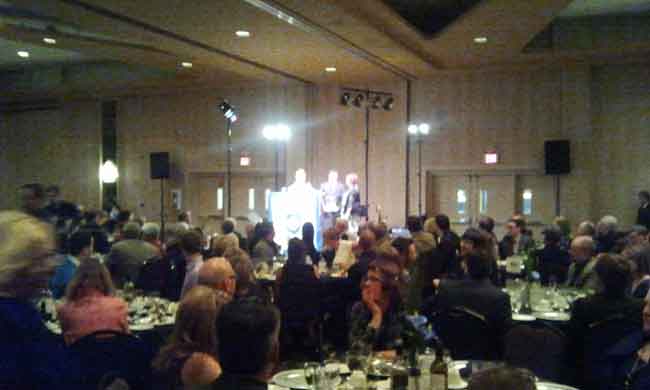
Just two weeks after receiving her Distinguished Woman Award from the YWCA, Mary has won the Management Student's Society's annual Teaching Award. The Award (complete with rather nice plaque) was presented at the annual Management Student Scholarship Banquet.

Mary hadn't wanted to go to the Banquet Thursday because she had had emergency wisdom tooth extraction Wednesday and still felt like someone was driving needles into her head--major painkillers notwithstanding--but one of the organizers insisted, so she dragged herself to it because, well, Mary is the type of prof who pushes herself to go out to support her students. So when her name was announced as this year's recipient of the Teaching Award, we understood why he had been so insistent!

I'm pretty proud of Mary. Nice to see her recognized for all the work she puts into her teaching...

Monday, April 02, 2012

Kiwanis Music and Speech Festival

Last week was crazy hectic for us. Tigana had three solo vocal performances, two school choir performances, and four solo recitations in Kiwanis Music and Speech Arts Festival this year.

Vocal Solo - Girls 13 & Under: - Own Choice:
Caro mio ben - G. Giordani
Musical Theatre Solo 13 & Under:
Wishing You Were Somehow Here Again - A. Loyd Webber
Contemporary/Modern Composers 13 & Under:
Beautiful - Duncan

Canadian Poetry Solo 14 & Under:
Lonely Land by A. J. M Smith
Narrative Dramatic Poetry 14 & Under:
The Highwayman Part I - A. L. Noyes
Solo Scene-Shakespeare 14 & Under:
A Midsummer's Night Dream, Act III Sc 3 - Helena
Solo Scene-Contemporary 14 & Under:
The Shape of a Girl - Joan MacLeod

Coincidentally, New West Theatre School's end of year performance was also last Wed evening. Which adds up to 10 different performances in seven days. . . .

Tigana took first place in all three vocal categories; she took first place for Highwayman, and second place for everything else. I was particularly impressed with her rendition of Caro mio ben, so help out a proud father and click on the link to view.

I have to say that I was very impressed by the quality of the feedback from the adjudicators. All three of the ones I observed with were extremely positive and supportive with all the contestants, and gave such helpful feedback, that I'd have to say it was some of the best teaching I've ever observed. Obviously they had the kids in the perfect 'teachable moment', but I swear I learned tons myself.

Kasia was also enrolled in New West Theatre School, though in a younger class so an earlier performance Wed night than Tigana.(Make that eleven performances in seven days for us to attend.) Kasia will likely start recitation lessons next year, and has already started vocal lessons, so will likely enter one or two Kiwanis categories too. So next year should be pretty interesting!

Friday, March 16, 2012

Upgrade

After putting it off for a long time, finally got around to updating Blogger template. But it has meant losing all the comments on previous posts. So it looks like no one has ever commented on my blog, which isn't quite right.

The problem is that I had been using a third party comment system rather than Blogger's because Blogger's original comment system never worked properly (problem with being an early adopter); but then the third party commenting software only worked for some readers -- others emailed complaints that their comments didn't take, or that it inserted eleven copies of their comments, or etc. I could never figure out why it only affected some readers and not others. Browser differences? Window vs Mac? Never seemed consistant. And then the third party company was bought out by another company; and then Blogger updated their system, which seemed to make the third party code work sometimes and not others, depending on how they got to the post.... And well, at some point, it was just getting stupid. Hit the wall this week when March 12 post received 400 hits, but only one comment on what should have been fairly provocative topic. When I tried, even I couldn't get it to accept my comment, so clearly nothing was working. So finally updated my template and even though that meant losing third party code, and have reverted to new and much improved Blogger interface for comments.

Now if no one comments, it's because no one's reading the blog anymore. (Well, who blogs in the age of Facebook?)

Monday, March 12, 2012

TED: Lessons Worth Sharing

TED's latest initiative, Lessons Worth Sharing, proposes to take the best lectures by the best lecturers, and animate them. This is a pretty neat idea, as illustrated by the short video explaining the concept. I am grateful to Nicola Simmoms for bringing this initiative to the attention of the online forum for Society of Teaching and Learning In Higher Education, to which I subscribe. In subsequent discussion, another member of the forum made the comment, "I cannot fathom a down side".

I agree that it is hard not to love anything connected with TED. But, um: being a sociologist, I can pretty much find the latent dysfunction of anything….

The subtle catch with the implementation of the best lecture concept is that each "lesson" is restricted to be ten minutes or under. So we get the best teachers, animate their ten minute lecture and post it as an example of great teaching. This then becomes the gold standard of teaching, against which all of lecturers are now going to be judged by their students. But one cannot reduce teaching to 10 minutes of lecture.

Sound Bite Thinking

Some concepts take longer than 10 minutes to develop. The bulleted points of web pages and powerpoint presentations, or the trend towards fast-cutting video, have already eroded our students attention spans, and sapped their patience for sustained argument. But many subtle ideas require students to really think their way through complicated, even convoluted arguments. Bringing data to bear on a problem, for example, allowing students to shift through and understand that data, requires more than 10 minutes. If TED implies to students (and instructors) that ten minutes is the longest tolerable length for lecture, I'm not convinced that that approach is necessarily going to promote critical thinking or sustained engagement.

Entertainment vs Engagement

I love the idea of someone animating my lectures…though my particular subject matter (say, the construction of multiple-choice test questions) may not always lend itself to that medium. But the problem here is that animated lectures are entertaining and perpetuate the idea that learning always should always be fun and effortless. Just as Sesame Street taught a generation of children that learning is fun -- with the unfortunate corollary that school should be likewise always be fun, and that if one's teacher isn't as entertaining as Kermit the Frog, one should change the channel -- there is a danger that viewers will expect their own instructors to be as entertaining as a TED Video.

This is a wrong idea: lots of what we have to do to achieve our learning goals is not fun. Practicing scales on the piano, learning the times table, reading scholarly articles, are inherently tedious but nonetheless necessary tasks. Instructors who focus on entertaining their students may do well in course evaluations, but it is not clear that their courses contain any actual content.

I work hard to make my classes engaging, but that is a very different matter than being entertaining. I hope that my passion for my subject shows through, and that at least some of my students catch something of that same enthusiasm, even as they engage in those activities that include an element of drudgery.

This is not to suggest that one should turn off Sesame Street or block TED video: obviously, the Lessons Worth Sharing initiative is producing a marvelous resource of which we should all avail ourselves. What I am suggesting is that we need to be aware that this is a medium we should exploit but not necessarily attempt to emulate in our own classrooms. It is not necessary, or even desirable, that we all start breaking our lectures into ten minute segments or hire animators.

Whose Knowledge?
I'm sure TED talks will cover all the great ideas of science, etc. But what about the social sciences, humanities, and so on? The whole point of having local campuses (besides allowing students direct access to instructors), is that we may not all agree with, say, American supply-side economics. Whose vetting what goes on TED's channel? Who is in charge of social construction of what constitutes really cool knowledge? Is TED going to include the lunatic fringe? Only the Mainstream? Is Somoa or Alberta going to see their ideas reflected on TED, or only America content? (TED hasn't done a bad job in the past of bringing speakers from around the world, so perhaps this need not be an immediate concern...but what we're watching bears watching.)

Contextualization
Another problem with crowd sourcing lectures is that without the larger context of a program of studies, concepts are presented out of order, without important qualifications, and without the necessary links/connections being drawn for the audience. Again, the TED Lessons might be a fabulous supplementary resource for teachers around the world, and for individuals seeking clarification of particular concepts, but it is important to understand that this is not sufficient to serve as a stand alone replacement for schooling. I do not say that TED has ever claimed that it would be, only that others will invariably ask, "Why can't it all be like this" and contextualization is part of the answer.

Good teaching is more than lectures
Good teaching has to be more than lecturing. I'm good with having a large resource of fabulous 10 minute introductions to big ideas available to my classes…but that does rather imply that the classroom instructors will be left with doing all the boring bits with their students. Students will therefore be inclined to make invidious comparisons between the fabulous animated lectures available online, and the dreary classes they have to endure on campus....

TED: Lessons Worth Sharing

But, you know, just saying.

Mostly, the TED initiative looks pretty cool to me.

Monday, February 13, 2012

Mary Runté Awarded Woman of Distinction

uweekly -- advancement_maryrunte_0037.jpg (4 documents, 4 total pages)
Uploaded with Skitch!

Excerpted from the Feb 13, 2012 University of Lethbridge Notices Board:


The YWCA Women of Distinction Awards recognize outstanding women who live and work in Southern Alberta.

Through a competitive process, the honourees are chosen from a group of nominations. The awards are based on the candidate’s accomplishments, commitment and leadership.

The Women of Distinction Awards Ceremony is a wonderful venue to showcase the talent and leadership of women in Southern Alberta. Women honoured have been trailblazers, entrepreneurs, innovators, social advocates, and volunteers.

Mary Runte: Woman of Distinction in the Spirit of Women category.

Mary Runté has a Ph.D. in Management from St. Mary's University and an MBA from York. She is an Associate Professor of Strategy and the Director of Social Responsibility in the Faculty of Management at the University of Lethbridge.

Previously, Mary worked with a variety of nonprofit organizations, including Eastside Young Moms and the Society of Special Needs Adoptive Parents (SNAP). Gender inequity, work-family balance, social responsibility and business ethics are her particular areas of interest and research, having numerous publications and having received major research grants to study these issues.

Mary was honoured as distinguished speaker for the Work-Life Conference at the University of Ochanamizu, Tokyo, Japan in 2007. She is the founding Division Chair for the Social Responsibility Interest Group of the Administrative Sciences Association of Canada.

Her tireless support of her students, especially female students in non-traditional fields, and her one-on-one mentoring throughout their academic careers is done on a volunteer basis. She is an incredible role model for students and colleagues alike as she advocates ceaselessly for ethical and principled business behaviour.

================================================================
From the Lethbridge Hearld, Monday, Feb 13, 2012.:

Runté credits her daughters as her inspiration to connect with other women.
"They are very different, unique souls, and to just be able to see that and to recognize that is one of the greatest honours I have in life; to be able to nurture that and allow it to grow without interference, but with support," she said. "And I say that with my students as well. Male and female, sometimes what they need is just to be noticed."

Runte is known for tirelessly supporting her pupils, particularly female students studying non-traditional fields, as well as her volunteer one-on-one mentoring.
"It's really validating when people notice something that you do simply because it's what you do," she said of winning the award.

========================================================
I am incredibly proud of Mary. I of course was aware of the impact she was having before the award, but it's nice to see her get some recognition for the work that she does.

Sunday, February 05, 2012

Hugo


Brilliant movie. I especially recommend the 3D version: excellent use of 3D effects without being cheesy. The casting was excellent, the direction flawless, and the spirit of the book could not have been better realized. An excellent adventure story with a payoff of understanding the origin of film. I took my 13 yr old and she loved the film as much as I and it initiated a great conversation on the history of the movies. Anyone remotely interested in the movies as an art form HAS to see this movie; everyone else should enjoy a really superb movie about a young boy's quest and the little side stories about life and love in the Paris railway station.

Tuesday, January 31, 2012

Split Decision

I am eligible for one of the 2012 Aurora Awards --Canada's top awards for Canadian Science Fiction and Fantasy--in the category, "Best Short Form Work in English," for my short story, "Split Decision" in Tesseracts 15: A case of Quite Curious Tales

The deadline for nominations is March 31, 2012, and the five works with the most nominations will be on the ballot. Only members of the Canadian Science Fiction and Fantasy Association can nominate or vote ($10 fee). You can nominate 3 works in each category. For a list of all eligible entries, check out 2011 Canadian SF or the Canadian SF Works Database.

If you liked "Split Decision" please consider nominating it. (Though with that title, you just know the best it could do is a tie!)

Sunday, January 08, 2012

Engine of Recall

The Engine of RecallThe Engine of Recall by Karl Schroeder

My rating: 4 of 5 stars


Schroeder makes my list of top ten authors, so I've been meaning to read this collection for some time. I tend to prefer novels to short stories for bed time reading, and I'd already read several of these when they first came out, including one I'd published myself as co-editor of Tesseracts 5 (and was subsequently reprinted in David Hartwell's anthology The Hard SF Renaissance) -- I like to think I was one of the editors that 'discovered' Schroeder, though that's pure pretension on my part--so hadn't got around to the collection. For one thing, I knew that they would be more downbeat than the novels, and that turned out to be true. His novels all have (relatively) happy endings. And I guess that is sort of true of the stories in the collection, though its the 'get-to=live-another=day,-not-quite-as-bad-as-it-could-have-been' Canadian-style endings here, rather than the 'achieved-our-goals' American-style happy endings. But for all that the stories tend towards the somber, I really enjoyed the book. The writing is excellent, his ideas are original, and its refreshing to read the Canadian version of the genre. And it's interesting to look at the evolution of Schroeder's writing: the man is a genius, one of the best hard SF writers around, so well worth reading his entire cannon. I look forward to his next collection.


View all my reviews

Donald Barr

Donald Barr was a significant figure in American post-secondary education, having been a professor, Dean, and author of Who Pushed Humpty Dumpty? Dilemmas in American Education (1971) a major book in the 1970s. He also wrote two SF novels near the end of his career, so he's a bit of a role model for me.


His first novel, Space Relations: A Slightly Gothic Interplanetary Tale is one of my favorites. I've just finished rereading it for the third time, and I almost never re-read novels. But his is one of the novels that comes closest to the one I'm trying to write myself. Having re-read my way through the Miles Vorkosigan series (which stands up very well to rereading) and as much of the Retief and Stainless Steel Rat and Agent of Vega books as I could stand (not nearly as good as my 15-year-old self remembered them), Space Relations was the last of the novels that heavily influenced my own first attempt at novel-writing.

Space Relations is the story of a very minor diplomat who is kidnapped and sold into slavery, but ultimately thinks his way through to escape. But it's way better than that summary makes it sound. It's clever and funny and sexy; an adult version of The Stainless Steel Rat or Retief, and the spy stuff is a lot better because, did I mention, Barr was also a former intelligence officer in the OSS.

What I learned from Space Relations is the importance of not explaining everything at the moment it happens. There's one rather clever bit of action early on in which the hero initiates a bit of a scene: the other characters (and the reader) assume he is just being a bit of a wise-ass out to annoy his captors, but about 15 chapters later the hero explains that this was a key turning point for him because it gave him the information he needed to escape. I've remembered that scene ever since I first read it 25 years ago. And I have therefore resisted the temptation to explain everything as it happens in my own novel, and I'm quite proud of a couple of bits where the reader doesn't get to know what's going on until later. Connie Willis is the other master of the same technique.


In contrast, I've had three manuscripts across my desk in the last three months in which the first-time novelists have answered the protagoists' questions within pages -- sometimes within paragraphs -- of their having posed them. How mysterious is a mystery that lasts three paragraphs? In each case I have had to point out to the authors that there is no tension in a puzzle that is solved the instant it is introduced. The contrast between these newbies and Barr's first novel made a very strong impression on me.

Unfortunately, Barr's second novel, A Planet in Arms is nowhere as good. I re-read it again too, in my enthusiasm for Space Relations, but now wish I hadn't. A Planet in Arms is much darker: the characters are less sympathetic, much of the action is unpleasantly gruesome, and Barr projects his American cold war politics a 1000 years into the future which is just embarrassing. Large portions of the novel drag as the 'action' slows to debates in the legislature -- more projection of American politics and stereotypical communist villians. In contrast to Space Relations' careful development of a single protagonist, the pov in Planet in Arms is fragmented between a half dozen characters -- the characters serve to tell the story of the revolution rather than allowing the revolution to motivate the actions of some character. I don't feel revolution makes for a good character. To be fair, there are still some (albeit dark) comedic bits, and the spy action is informative, so the book isn't awful...but no Space Relations.

Space Relations: worth seeking out, but it's a one-off.